
The game, briefly
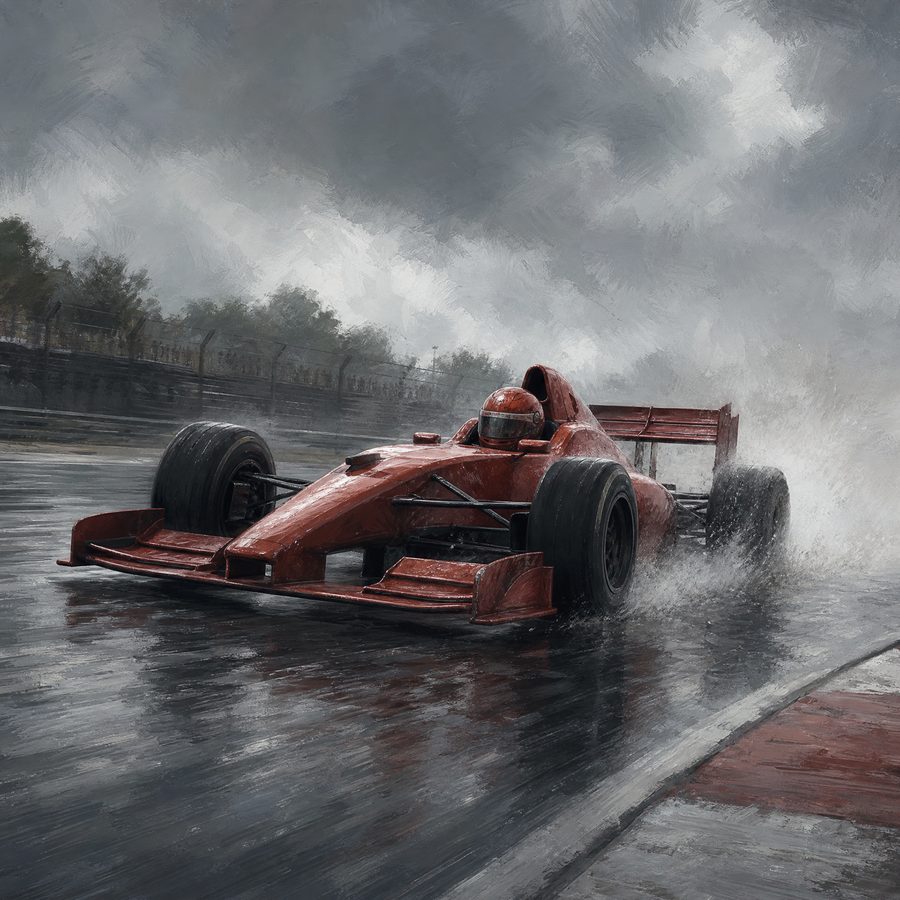
A single-seater racing game concerned with grip rather than spectacle, at its best in wet conditions where throttle discipline decides everything. The tyre model communicates through resistance and response in a way that makes the analogue inputs feel like instruments rather than switches.
Two thirds of this review is praise for that. The remaining third is about a settings screen that appears to have been finished before anyone connected unusual hardware to it.
Input count
Twenty-three bound actions, peak simultaneous demand of five, which occurs during a wet-weather pit sequence where you are braking, downshifting, requesting the pit and managing two dials at once. Three sustained holds, all short.
The analogue axes are handled properly: throttle and brake both accept partial input from any axis-capable device and the deadzone controls are among the best documented in the archive. The failures here are not in the analogue layer at all — they are in the digital bindings wrapped around it.
| Measure | Wet Circuit | Bench 26 median |
|---|---|---|
| Bound actions | 23 | 19 |
| Peak simultaneous | 5 | 4.5 |
| Sustained holds | 3 | 2.5 |
| Default chord bindings | 2 | 1 |
| Analogue axes supported | 6 | 2 |
The rebinding audit
Seventy-eight per cent. Five actions are fixed: the pit request, two dial adjustments, the replay toggle and the horn. The pit request being both fixed and bound to a chord by default is the one that causes real harm, because it is required at speed and cannot be moved.
Chord defaults are defensible when they can be changed. Here the two-button pit request cannot, which means any device that cannot express two simultaneous digital presses loses access to pit strategy entirely — and pit strategy is roughly a third of the game's decision-making.
The analogue model here is better than the rest of this bench combined. The five fixed digital bindings around it undo that work for anyone whose hardware does not match the assumption.
The three failures, in order of cost
- Pit request fixed to a two-button chord — removes pit strategy on assistive hardware.
- Adaptive switch box not detected at all — the device does not appear in the menu, so nothing can be assigned to it.
- Dial adjustments fixed to a modifier hold, awkward on a pad and impossible on some devices.
Across four devices
Excellent on a pad, where the analogue triggers do most of the work and the fixed chord is uncomfortable but reachable. Good on keyboard, though the analogue modelling that makes the game special is largely lost to digital input, which the game acknowledges with a genuinely useful warning on the setup screen.
On a flight stick it works better than expected, since the axes map sensibly. On the adaptive switch box it does not work at all: the device is not enumerated, does not appear as an assignable input, and no combination of profiles brings it into the game. That is a detection failure rather than a mapping failure, and it is the most complete exclusion recorded in this bench.
| Device | Playable | Notes |
|---|---|---|
| Standard pad | Fully | Best experience; chord awkward but reachable |
| Flight stick | Yes | Axes map sensibly, digital bindings cramped |
| Keyboard and mouse | Yes, diminished | Analogue nuance largely lost, game says so |
| Adaptive switch box | No | Device not detected; nothing assignable |
Verdict
Seven point two. On a pad this is an eight and the best driving model in the archive this year. The deductions are for five bindings and one missing device layer, all of which sit in a settings screen rather than in the simulation.
The frustrating part is that the team clearly cares about input — nobody models brake pressure this carefully by accident. The care simply stopped at the boundary of the hardware they had on their own desks, which is the most common failure pattern in twenty-six benches.