Input count
Every distinct action the game binds, and the peak number required simultaneously during normal play. Counted from the binding screen and verified in the hardest section we reached.
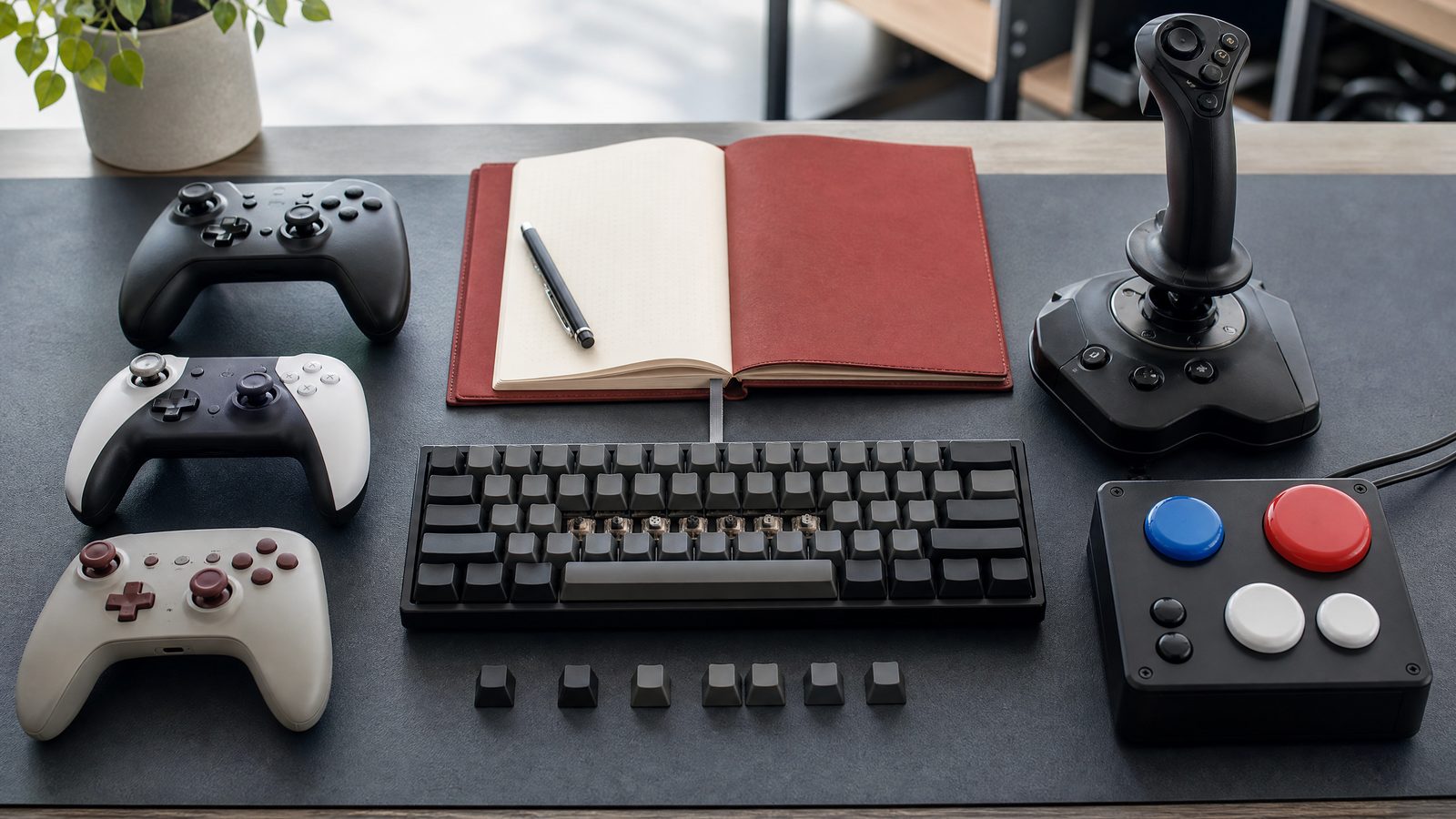
An excellent fighting game with a control scheme that assumes one kind of hand. We counted every input it demands, tried to rebind all of them, and mapped what is left for anyone the default layout does not fit.
Most reviews describe how a game feels to the reviewer. This one counts what the game asks for, in specific units, so you can work out whether it will ask that of you.
Every distinct action the game binds, and the peak number required simultaneously during normal play. Counted from the binding screen and verified in the hardest section we reached.
How much of the scheme can actually be reassigned in the menu. Actions locked out of rebinding are listed by name, because that list is what determines whether a game is usable.
Sustained holds, double-taps, charge inputs and anything with a timing window under 200 milliseconds, with a note on whether a toggle or assist alternative exists.
What survives the move from pad to keyboard to switch box. Some games are one scheme in three costumes; others quietly become a different game on different hardware.
Each entry lists the peak simultaneous input count, the share of actions that can be rebound, and the number of held inputs with no toggle alternative.
 7.9
7.9
Superb at the top level and openly indifferent to hands that do not match the default. Nine inputs at peak, four of them locked out of rebinding entirely.
 8.6
8.6
Three buttons, everything rebindable, and a hold that can be switched to a toggle in two clicks. The cheapest good example in twenty-six benches.
 8.1
8.1
Two hundred and six bindings, all of them reassignable, and a genuinely good scheme on a pad. The rare simulator that does not require a stick to be sane.
 6.4
6.4
Good tactics, hostile hands. Lean, crouch and mark are all holds with no toggle, and the rebinding screen refuses six actions without explanation.
Turn-based, mouse-first, and the only game in the bench that works identically on all four devices because it never asks for two inputs at once.
Analogue throttle and brake done properly, then undermined by a menu that cannot see a switch box at all and a pit request bound to a chord.
Full rebinding costs a developer perhaps two days of work in a menu that already exists. Thirty-nine per cent of the games benched still do not offer it, and in almost every case the actions locked out are the ones most likely to hurt: holds, chords and quick-time prompts.
None of this is about difficulty. A game is entitled to be hard. It is not obliged to be hard in exactly one physical shape.
Each bench is run with three additional testers using their own hardware, and their notes go in unedited except for length.
The switch box test is the one nobody else runs. Two of the six games in this bench simply cannot see the device, and that fact does not appear in a single storefront description.
Tester on the adaptive boxBench 26, all six titlesI have played fighting games for twenty years and Splinter Arena still hurt after ninety minutes. Counting the inputs made me realise it was not me being old, it was five holds stacked on one hand.
Tester on padSplinter Arena, 14 hoursRed Pillars is the argument. Three buttons, every one rebindable, a toggle for the only hold, and it is still the most demanding platformer here. Accessibility did not cost it anything.
Tester on keyboardRed Pillars, 22 hours